
Status: October 2026. This article is general guidance and not legal advice. The rules change, and in individual cases the local authority decides. Clarify your location with the local regulatory office (Ordnungsamt) or legal counsel.
In short: Whether an unstaffed shop may open on Sundays is regulated by each federal state in Germany itself. Hesse and Bavaria created explicit rules for digital micro-supermarkets in 2024 and 2025 respectively, in North Rhine-Westphalia the Higher Administrative Court granted vending-machine outlets Sunday opening in summary proceedings, and Schleswig-Holstein followed in 2026. For the sale of alcohol and tobacco, the Youth Protection Act (JuSchG) applies regardless of the federal state: supply to minors is prohibited, and violations cost up to €50,000. Cameras in the shop are permitted under the GDPR (DSGVO) if they are necessary and customers are informed in advance.
1. Opening hours: state law, not federal law
Since the federalism reform of 2006, shop-opening law has been the responsibility of the states. Normally, retail outlets are closed on Sundays and public holidays. A shop without staff is not automatically an exception in law, as the case of Hesse shows.
Hesse: court ruling and amendment to the law
On 22 December 2023, the Hessian Higher Administrative Court (Hessischer Verwaltungsgerichtshof) ruled that the shop-opening act also applies to digitally operated outlets without sales staff, meaning the city of Fulda was entitled to prohibit Sunday opening of the "Teo" stores. The state parliament then amended the Hessian Shop Opening Act (Hessisches Ladenöffnungsgesetz) with a law of 10 July 2024: "digital micro-supermarkets" are fully automated outlets with a sales area of at most 120 square metres that operate without sales staff and offer only everyday goods. They may open from 0:00 to 24:00. On Sundays and public holidays, no staff may be deployed, not even for restocking; empty shelves stay empty until the next working day. (hsgb.de, aga.de)
Bavaria: new Shop Closing Act since 1 August 2025
The Bavarian Shop Closing Act (Bayerisches Ladenschlussgesetz, BayLadSchlG) entered into force on 1 August 2025. Under Art. 2 para. 2, unstaffed micro-supermarkets with a sales area of up to 150 square metres may also open outside the general shop-closing times, provided that selection, handover and payment take place via vending machines or self-service and no staff are deployed for sales, maintenance, restocking or cleaning during that time. Municipalities may limit opening on Sundays and public holidays by ordinance, but not to fewer than eight consecutive hours. (Publicus/Boorberg)
North Rhine-Westphalia: summary ruling on vending machines
On 12 February 2025 (case no. 4 B 976/24), the Higher Administrative Court of NRW (Oberverwaltungsgericht) ruled in summary proceedings that a vending-machine kiosk in Bonn may provisionally remain open on Sundays and public holidays as well. Vending machines as automatic sales facilities have therefore been allowed to be usable all day on every day since 1962; the legislature retained this exception. The case concerned a kiosk with individual machines and is a provisional decision, not a free pass for every walk-in shop. (Justiz NRW)
Schleswig-Holstein: special rule for small municipalities
Since 3 June 2026, Section 8b of the Schleswig-Holstein Shop Opening Hours Act (Ladenöffnungszeitengesetz) applies (Act of 22 May 2026, Law and Ordinance Gazette (GVOBl.) no. 49 of 2 June 2026). It allows unstaffed micro-supermarkets with up to 350 square metres of sales area to open during closing hours, and therefore on Sundays and public holidays, but only in municipalities and towns with up to 2,500 inhabitants. No person may be present for the purpose of selling; the act expressly counts restocking and regular cleaning as sales activities. Supermarkets in this sense are businesses that predominantly sell food only. Shops already operating without staff keep the option even if the population later rises above 2,500. Under Section 8a, individual vending machines or groups of machines up to seven cubic metres in volume may also sell during closing hours. (legal text, GVOBl. 2026 no. 49, government bill, Landtag printed paper 20/3750)
All other states
The situation is a patchwork, and changes keep coming. Before planning, ask the municipality or the regulatory office what applies at your location: Sunday opening, permitted area, range restrictions (above all "everyday goods") and staff deployment on Sundays.
Practical consequence for your planning: Where staff deployment on Sundays is excluded, your shop must also schedule restocking on working days and operate the technology in such a way that nobody has to intervene on site on Sundays. Remote monitoring and remote maintenance are the foundation for this.
2. Youth protection: alcohol and tobacco
The Youth Protection Act (Jugendschutzgesetz, JuSchG) applies nationwide, including at self-checkout.
- Alcohol (§ 9 JuSchG): Beer, wine, sparkling wine and similar drinks may not be supplied to children and young people under 16, other alcoholic drinks (spirits, mixed drinks) not to minors. (gesetze-im-internet.de, § 9 JuSchG)
- Tobacco and nicotine-containing products (§ 10 JuSchG): Not to minors. Under para. 4, this also applies to nicotine-free e-cigarettes and e-shishas. (gesetze-im-internet.de, § 10 JuSchG)
- Vending machines: In public, alcohol and tobacco may not be offered via vending machines, unless the machine is located in a place inaccessible to minors or technical devices prevent removal (§ 9 para. 3, § 10 para. 2 JuSchG).
- Fine: Anyone who supplies alcohol to minors contrary to § 9 para. 1, or tobacco contrary to § 10 para. 1, commits an administrative offence that can be punished with a fine of up to €50,000 (§ 28 JuSchG). (gesetze-im-internet.de, § 28 JuSchG)
What does this mean for self-checkout?
The law does not prescribe a particular technology for age verification. The operator is responsible and must ensure that age-restricted goods do not go to minors. In practice, several methods are used: checking by ID or card, release by staff remotely, or an age estimate by camera. For the latter, according to an industry article, data-protection questions remain open. (drs-ag.de) In a DATO-IT shop, age verification for alcohol and tobacco is integrated into the self-checkout. Which method is sufficient for your location should be agreed with the competent authority.
3. Cameras and data protection
Video surveillance in the sales area is processing of personal data and is governed by the GDPR (DSGVO).
- Legal basis: For non-public bodies, Art. 6(1) sentence 1 point (f) GDPR (legitimate interests) is regularly considered, for example protection against theft. The German Data Protection Conference (Datenschutzkonferenz) expressly names goods monitoring in retail as an example, but requires necessity and a balancing against the interests of the data subjects. Cameras in toilets, changing rooms and similar areas are regularly impermissible.
- Notice before entry: The surveillance and the controller must be notified before entering the area. The Data Protection Conference recommends a two-stage approach: a notice sign at eye level with the key information and a full information sheet that is available on site or accessible online.
- Retention period: Recordings must be deleted without undue delay when they are no longer needed. In the view of the Data Protection Conference, a retention period of 72 hours is generally sufficient; longer periods require special justification. (DSK guidance on video surveillance, status 17.07.2020)
- Access by card or app: Access logs and app payments also generate personal data and belong in your privacy notice.
Frequently asked questions
May my 24/7 shop open on Sundays? That depends on the federal state, the sales area and, in part, the municipality. Hesse, Bavaria and Schleswig-Holstein have special rules with area limits; in NRW there is a summary ruling of the Higher Administrative Court on vending machines. Ask your regulatory office before planning.
How does age verification work without staff? At DATO-IT, age verification for alcohol and tobacco is integrated into the self-checkout. Which method is sufficient at your location is decided by the competent authority; raise this early.
Do I have to give notice of cameras? Yes. Before entry, a notice about the video surveillance, including the controller, must be visible, supplemented by detailed information.
Do I have to sell alcohol and tobacco at all? No. A range without alcohol and tobacco simplifies age verification but costs revenue. You can add it later.
Next step
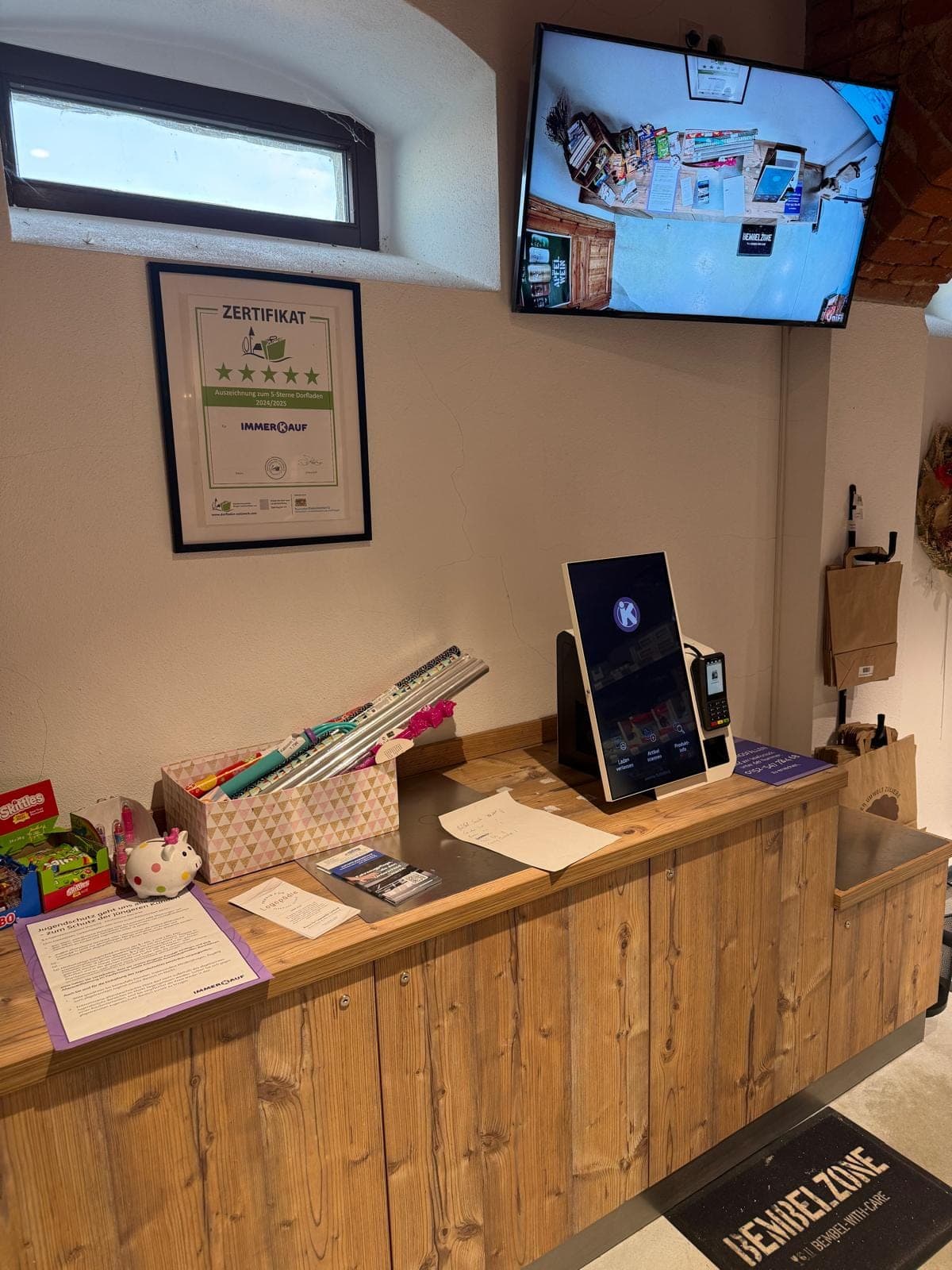
We plan access, self-checkout, age verification and cameras to suit your location, and we align the technology with your planning. Describe your project via the form on the page 24/7 shop container or 24/7 shop in hotels, or contact us via Contact. Our project Immer(K)auf in Taupadel shows an example with age verification.
Note: This article does not replace legal advice. Status: October 2026.